Showing posts with label Fibers. Show all posts

Friday, 6 July 2018

Fibers for Manufacturing Denim

Cotton is the major fiber used for the manufacture of denim. quality and staple length of the fiber is of crucial importance. Denim would not be denim without cotton. Now-a-days the cultivation of cotton fibers have grown sustainability issues due to higher water and pesticide consumption.

Today many variations of cotton fibers are used for manufacturing of denim fabric. Today organic and naturally colored cotton has a higher importance. Genetically modified cotton has also been cultivated to reduce sustainability issues. Cotton is also blended with Lycra, Polyester, Lyocell, Wool, Flax and Hemp for the manufacturing of special types of denim. There is a possibility they can even replace the original cotton fiber due to their higher usage in denim sector.

Saturday, 21 February 2015

Determination of tensile strength of cotton grey fabric by strip method.


Abstract:
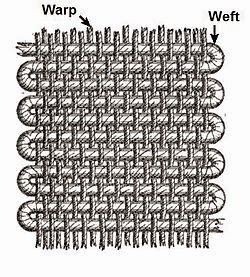
In this experiment the tensile strength of cotton grey fabric was calculated having a plain weave design. The experiment was performed according to the ASTM test method D5035. The tensile strength of fabric from both warp-wise and weft-wise direction was calculated. It was noted that warp-wise strength of fabric is more than that of weft-wise tensile strength.

Wednesday, 24 December 2014

“Armos Fiber” Russian Aramid Fiber


Introduction

In the 1980's and 1990's a more advanced terpolyaramid was developed and put into production made from three monomers, two monomers forming PPTA which are the same as para-aramid. 
Khimvolokno Scientific – Production Association (now the All-Russian Scientific-Research Institute of Polymer Fibres) produced it and later T'ver (Tvervolokno now closed) produced Armos®. The main features of this fibre were long life time under the load (more than 15 years), high modulus and was produced without any sizing.

Thursday, 4 December 2014

Compare the tensile strength of Ring spun and Rotor spun yarns having same count (20s).


Abstract:
In this experiment different properties of ring and rotor spun yarns were compared. The properties studied are breaking work, breaking force, tenacity and elongation of ring and rotor yarns. The yarns used for this experiment both have 10s count. The results showed that the ring spun yarns have good properties then the rotor spun yarns.

To compare the single yarn strength of given sample of yarns having different twists and same count (20s).


Abstract
The strength of a yarn greatly depend upon its twists per unit inch also called TPI. Yarn is simply a strand of fibers. Fibers are joined together to form a yarn. The binding force between the fibers is the twist given to the yarn at the time of spinning. The twist gave the fibers a binding force to make a yarn. This twist is very important for the yarn because it determines many characteristic properties of the yarn like air permeability, moisture absorption, feeling, dye ability and strength.
This experiment is conducted to check the strength of yarn at different twists levels. The yarn twist has an optimum value by-passing which the strength of yarn starts decreasing. This is called the optimum twist. Yarn length also start deceasing by over-twisting.

Sunday, 9 November 2014

Compare the tensile strength of dry and wet cotton yarns by lea method and calculate their CLSP.


Abstract:

The strength along the length of a body is known as its tensile strength also called linear strength of that body. In the textile fibers or yarns only tensile strength is calculated due to high length to width ratio of the textile materials. The tensile strength values of the dry and wet cotton yarns varies very much from each other. The strength of wet cotton yarns is greater than that of dry cotton yarns. This is due to the formation of hydrogen bonds between the water molecules and the hydroxyl groups in the cellulosic rings of the cotton fibers in the wet state. There is one phenomenon known to stand that when the cotton gets wet its crystalline region increases hence the strength of the fibrous structure increases.

Wednesday, 17 September 2014

Manufacturing of Viscose Rayon – Viscose Process


Viscose Process

It is the worldwide manufacturing process of "Viscose Rayon".

Raw Materials

  • Wood Pulp
  • Cotton Waste
  • Cotton Linters
Viscose Process is as follows:

Tuesday, 16 September 2014

History of Viscose Rayon


  • Viscose Rayon is the very first viable manufactured fiber and artificial silk fiber.
  • In 1664, English naturalist Robert Hooke gave a theory that artificial silk filaments can be spun from a substance similar to that which silkworms utilize to make silk.

Sunday, 14 September 2014

Relationship between Properties and Structure of Viscose Rayon


In general, the fiber structures of various viscose fibers depend on the properties such as conditions of viscose, acid bath, stretching, regeneration and so forth. In the case of ordinary rayon, in which an acid bath offering high coagulative and regenerative powers is used, the major portion of fiber structure is determined in acid bath. For viscose fibers, however, in which a weak acid bath is employed, the regeneration and crystallization of fibers in acid bath are only carried out to a small extent and the fiber structure is not only dependent on acid bath conditions but also on the stretching and regeneration conditions. Consequently, a wide choice of fiber structures and properties is available by combining such factors such as viscose, acid bath, stretching and regeneration.

Structure of Viscose Rayon


The structure of rayon fiber is generally that of smooth, inelastic filaments like glass rods. However, different processes, additives and finishes can vary the physical appearance and structure of viscose rayon.

Properties of Viscose Rayon


Rayon as a fabric is soft and comfortable. It drapes well which is why it is highly sought after as an apparel fabric. Most characteristics are variable depending on processing, additives and other finishing treatments and fabric construction.

Monday, 8 September 2014

Preparation of Viscose Rayon


Rayon fiber made from "viscose process" is called Viscose Rayon. Viscose Rayon is the oldest commercial manmade fiber. Viscose Rayon is a manufactured fiber composed of regenerated cellulose. Out of all the fibers produced, rayon is the most perplexing to consumers. It can be found in cotton-like end uses as well as silk-like end uses. It may function successfully in absorbent hygiene and incontinence pads and equally well providing strength in tire cords. Unlike most man-made fibers, rayon is not synthetic. It is generally made from wood pulp which is a cellulose-based raw material. Hence, properties of rayon are more like natural cellulosic fibers, such as lint or cotton, than those of synthetic fibers.

What is Fiber Science?


Fiber science is a very important and fundamental field in textile. Fiber science deals with the physical, chemical and engineering properties of fibrous materials and their applications but mainly it deals with physical properties of fibers. Fiber science helps determine the properties and structure of fibers. It is detrimental in identifying all kinds of fibers through physical and chemical methods and telling those fibers apart from each other. Popular methods for the identification of fibers in a fabric are absorption of infrared radiation, Raman scattering of light, X-ray diffraction studies and optical microscopy.

Sunday, 7 September 2014

Raw Materials for Woolen Industry


Wool is the animal fiber forming the protective covering, or fleece, of sheep or of other hairy mammals, such as goats and camels. Prehistoric man, clothing himself with sheepskins, eventually learned to make yarn and fabric from their fiber covering. Selective sheep breeding eliminated most of the long, coarse hairs forming a protective outer coat, leaving the insulating fleecy undercoat of soft and fine fiber.

Impurities Present in Raw Wool


The proportions of the different components of unwashed or greasy wool are:
  • Moisture = 4 – 24 %
  • Yolk = 12 – 22 %
  • Dirt = 3 – 9 %
  • Wool Fibers = 60 – 70 %
Raw wool contains three main impurities

Monday, 18 August 2014

Structure of Protein Fibers


The following is the note on the structures of protein fibers. However, first we have to know about the basic concept about the protein and structure of protein.

Introduction

The protein fibers are the fibers whose origin is protein. They are formed by the natural animal source through condensation of a (alpha)-amino acids to build repeating units of polyamide with many substituents on a (alpha)-carbon atom. The sequence and the type of the amino acids bonding together the on individual protein chains contribute to the overall properties and characteristics of the resultant fibers. There are two major classes of natural protein fibers exist. They are as following
•    Keratin (hair or fur) and
•    Secreted (insect) fibers.
In general, protein fibers have moderate strength, resiliency, and elasticity. Their moisture absorbency and transport characteristic is excellent. They do not produce static charge. While they are resistant to acids, they are easily attacked by bases and oxidizing agents. They tend to yellow color on exposure to sunlight due to oxidative attack.
Example of protein fibers are wool, silk, mohair, cashmere etc.

New Website

Dear viewers, We wanted to let you know that we are moving to a new website, and we'd love for you to come along! Starting on 20 March 2...